

Robotic Hip and Knee Replacement: What Are the Real Benefits?
By Mr Philip Dobson, Consultant Orthopaedic Surgeon specialising in knee and hip conditions in Newcastle (Newcastle Hospitals NHS and Nuffield Health).
Robotic-assisted joint replacement is becoming increasingly available for patients undergoing hip and knee replacement surgery.
The term “robotic surgery” can sometimes be misleading. The robot does not perform the operation independently, and it does not replace the surgeon. Instead, robotic technology provides detailed planning information and helps the surgeon carry out the agreed surgical plan with a high degree of accuracy.
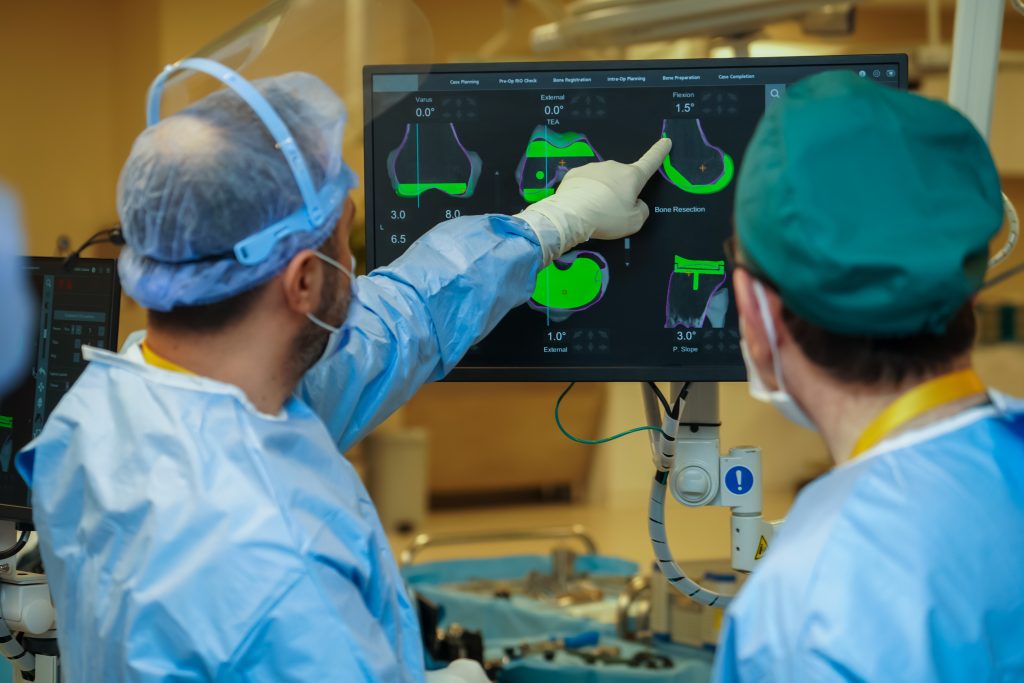
I use the MAKO robotic-arm system for suitable hip and knee replacement procedures. It allows the operation to be planned around each patient’s individual anatomy, rather than relying on a standard approach for every patient.
What is robotic-assisted joint replacement?
Robotic-assisted joint replacement combines computer software, detailed anatomical information and a robotic arm controlled by the surgeon.
For MAKO hip and knee replacement, a three-dimensional model of the joint is created from a CT scan before surgery. This allows the position and size of the implants to be planned in advance.
During the operation, the system provides real-time information and helps the surgeon perform the planned bone preparation within defined boundaries.
The surgeon remains in control throughout the procedure and makes all of the important clinical decisions.
Does the robot perform the operation?
No.
The surgeon performs the operation and controls the robotic arm at all times. The system cannot operate independently or make decisions on its own.
It is better to think of the robot as a highly sophisticated surgical tool. It provides additional information, planning and control, but the surgeon’s experience and judgement remain essential.
What are the potential benefits of robotic surgery?
The principal advantage of robotic-assisted surgery is greater precision and consistency in carrying out the surgical plan.
Potential benefits include:
- Detailed three-dimensional planning before surgery
- Accurate positioning of the joint replacement components
- The ability to tailor the operation to the patient’s anatomy
- Real-time assessment during surgery
- Controlled preparation of the bone
- Additional information to help balance the knee
These features may help the surgeon reproduce the planned implant position more consistently.
How does robotic knee replacement work?
In a robotic knee replacement, the surgeon can assess the alignment of the leg, the pattern of arthritis and the tension of the ligaments around the knee.
The planned implant position can then be adjusted to reflect the individual patient’s anatomy and soft-tissue balance.
The robotic arm helps the surgeon prepare the bone within carefully defined boundaries. This is designed to reduce unintended variation and allow accurate positioning of the knee replacement.
This personalised approach is one of the main potential robotic knee replacement benefits.
How does robotic hip replacement work?
In robotic hip replacement, the preoperative three-dimensional plan helps the surgeon assess:
- The size and position of the hip implants
- The orientation of the socket
- Leg length
- Hip offset
- The relationship between the implants and the patient’s anatomy
During the operation, the robotic system provides information to help reproduce this plan.
Accurate implant positioning is important in hip replacement, although the final result also depends on factors including surgical technique, rehabilitation and the patient’s individual anatomy.
Is robotic joint replacement better than conventional surgery?
Robotic-assisted surgery has consistently been shown to improve the accuracy of implant positioning and reduce the number of cases falling outside the intended alignment range.
However, greater accuracy does not automatically mean that every patient will experience less pain, faster recovery or a better long-term result.
Research comparing robotic and conventional joint replacement is continuing. Some studies report early improvements in certain measures, while others find similar patient-reported outcomes despite more accurate implant positioning.
It is therefore more accurate to say that robotic technology provides the surgeon with additional planning and precision rather than guaranteeing a superior result.
Does robotic surgery cause less tissue damage?
The robotic system allows bone preparation to be performed within predefined boundaries and may help reduce unnecessary disturbance of surrounding structures.
However, robotic joint replacement is still major surgery. The incision, rehabilitation requirements and general recovery principles are broadly similar to those following a conventional joint replacement.
Patients should be cautious about claims that robotic surgery is automatically “minimally invasive” or guarantees a rapid recovery.
Is recovery quicker after robotic joint replacement?
Some patients recover quickly following robotic-assisted surgery, but recovery varies considerably between individuals.
Factors affecting recovery include:
- General health and fitness
- Muscle strength before surgery
- Severity of arthritis
- Pain response
- Commitment to rehabilitation
- The complexity of the operation
The technology used during surgery is only one part of the overall treatment pathway.
Patients considering surgery may find it helpful to read more about what to expect after knee replacement surgery.
Can robotic technology be used for partial knee replacement?
Yes.
Robotic technology can be particularly useful in partial knee replacement, where only the damaged compartment of the knee is replaced.
The system helps the surgeon plan the position of the smaller implants and assess how the knee moves throughout its range of motion.
However, not every patient with knee arthritis is suitable for a partial replacement. The decision depends on the location of the arthritis, the condition of the ligaments and the patient’s symptoms.
Who may be suitable for robotic joint replacement?
Many patients who require a primary hip, total knee or partial knee replacement may be suitable for robotic-assisted surgery.
Suitability depends on factors including:
- The pattern and severity of arthritis
- Previous operations
- Bone anatomy
- General medical health
- The type of replacement required
- Individual treatment goals
A specialist assessment is required to determine whether surgery is appropriate and whether robotic assistance offers a useful option.
When should joint replacement be considered?
Joint replacement is generally considered when arthritis is causing persistent pain, stiffness and loss of function despite appropriate non-surgical treatment.
Some patients can manage their symptoms for a period with physiotherapy, medication or injection treatments. These options may help selected patients delay knee replacement surgery, although they do not reverse established arthritis.
When pain is substantially affecting sleep, mobility, independence or quality of life, knee replacement surgery or hip replacement surgery may become the most reliable treatment.
Does the surgeon still matter?
Yes. The experience and judgement of the surgeon remain central to the outcome.
Robotic technology can provide detailed information and help execute the surgical plan accurately, but it cannot determine whether surgery is appropriate, choose the correct treatment for the patient or manage unexpected findings independently.
The best results come from combining appropriate patient selection, experienced surgical judgement, accurate technique and effective rehabilitation.
Specialist assessment
If hip or knee arthritis is significantly affecting your quality of life, a specialist assessment can help clarify whether joint replacement is appropriate.
I offer conventional and MAKO robotic-assisted joint replacement for suitable patients undergoing hip, total knee and partial knee replacement surgery in Newcastle. You may also find my broader overview of robotic assisted joint replacement helpful.
The aim is to develop an individual treatment plan that reflects your symptoms, anatomy, activity level and personal goals.
Mr Philip Dobson, Consultant Orthopaedic Surgeon offers consultations and treatment at Nuffield Health Newcastle