

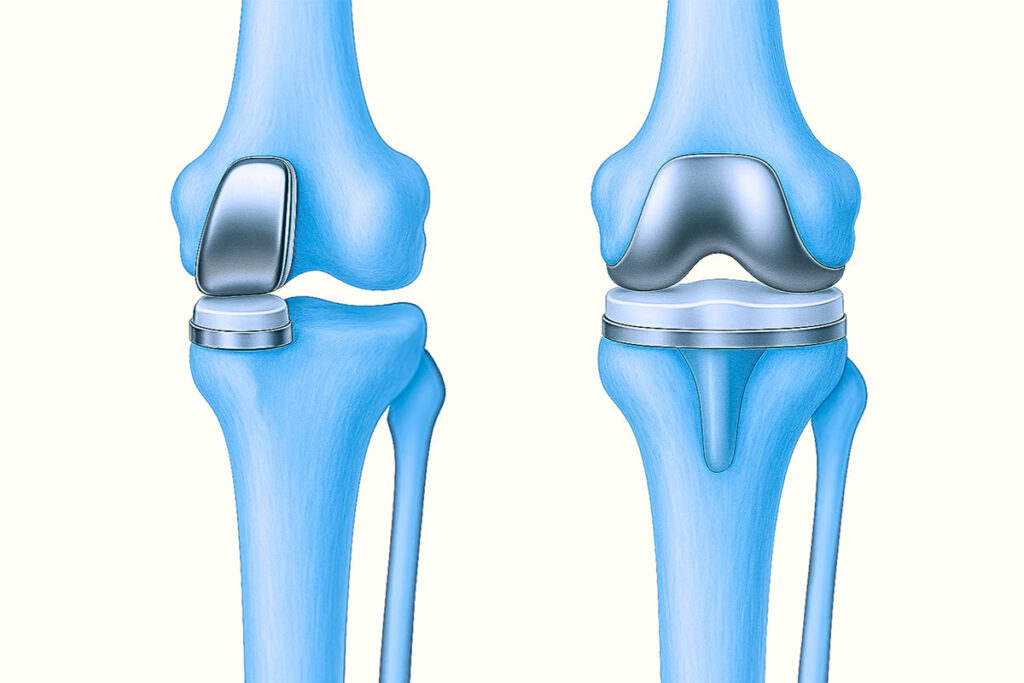
When Do You Need a Knee Replacement?
By Mr Philip Dobson, Consultant Orthopaedic Surgeon specialising in knee and hip conditions in Newcastle (Newcastle Hospitals NHS and Nuffield Health).
Knee replacement surgery is a highly effective treatment for advanced knee arthritis, but it is usually considered only when non-surgical treatments are no longer providing sufficient relief. Many patients live with knee pain for years before reaching the point where surgery becomes the best option.
Understanding when knee replacement may be appropriate can help you make informed decisions about your treatment and future mobility.
The most common reason: knee osteoarthritis
The most common reason for knee replacement surgery is osteoarthritis. This is a condition in which the smooth cartilage covering the ends of the bones gradually wears away. As the cartilage becomes thinner, the joint becomes inflamed, stiff, and painful.
Osteoarthritis typically develops gradually and may initially cause only mild discomfort. Over time, however, symptoms often worsen and begin to affect everyday activities such as walking, climbing stairs, or standing for longer periods.
While osteoarthritis cannot be reversed, knee replacement surgery can reliably relieve pain and restore function when symptoms become severe.
Symptoms that suggest knee replacement may be appropriate
There is no single test that determines when knee replacement is needed. Instead, the decision is based primarily on the severity of symptoms and their impact on quality of life.
Common signs that knee replacement may be appropriate include:
- Persistent knee pain that limits daily activities
- Pain that interferes with walking, exercise, or hobbies
- Difficulty climbing stairs
- Stiffness, particularly in the morning or after rest
- Pain at night that affects sleep
- Increasing reliance on pain medication
- Reduced independence or mobility
Many patients find that their world gradually becomes smaller as knee pain limits their ability to remain active.
When non-surgical treatments are no longer effective
Knee replacement is usually considered only after appropriate non-surgical treatments have been tried.
These may include:
- Physiotherapy to strengthen muscles and improve joint function
- Activity modification
- Pain relief medication
- Anti-inflammatory medication
- Joint injections
These treatments can often provide relief, particularly in the earlier stages of arthritis. However, as arthritis progresses, their effectiveness may diminish.
When symptoms persist despite these measures, knee replacement may offer the most reliable long-term solution.
X-rays and specialist assessment
X-rays are useful in confirming the diagnosis and assessing the severity of arthritis. They typically show narrowing of the joint space, bone spurs, and other changes associated with cartilage loss.
However, the decision to proceed with knee replacement is not based on X-rays alone. Some patients with severe arthritis on imaging have relatively mild symptoms, while others with moderate arthritis experience significant pain.
The most important factor is how much the knee is affecting your quality of life.
Knee replacement is an elective and personal decision
Knee replacement surgery is elective, meaning it is not mandatory or urgent in most cases.
The right time for surgery is when:
- Pain significantly affects your daily life
- Non-surgical treatments are no longer effective
- You feel ready to proceed
There is no benefit in delaying surgery unnecessarily once symptoms have become severe, but equally, surgery should only be undertaken when patients feel comfortable with the decision.
Modern knee replacement is a safe and highly successful procedure, with excellent long-term outcomes.
Outcomes of modern knee replacement surgery
Knee replacement surgery is one of the most successful procedures in modern medicine. The vast majority of patients experience significant pain relief, improved mobility, and a return to normal daily activities.
Many patients are able to walk comfortably, travel, exercise, and enjoy activities that had previously become difficult or impossible.
Advances in surgical technique, implant design, anaesthesia, and rehabilitation have all contributed to faster recovery and excellent long-term results.
When to see a specialist
If knee pain is affecting your quality of life, it may be helpful to see a specialist for assessment and advice.
A specialist consultation can help:
- Confirm the diagnosis
- Explain treatment options
- Identify appropriate non-surgical treatments
- Advise whether knee replacement may be beneficial
In many cases, patients benefit from reassurance, guidance, and a clear understanding of their options, even if surgery is not immediately required.
Summary
Knee replacement may be appropriate when arthritis causes persistent pain, limits mobility, and no longer responds to non-surgical treatment.
The decision is based on symptoms, quality of life, and individual circumstances. Modern knee replacement surgery is highly effective and can significantly improve comfort, mobility, and overall wellbeing.
Early specialist assessment can help ensure that the right treatment is offered at the right time.
Mr Philip Dobson, Consultant Orthopaedic Surgeon offers consultations and treatment at Nuffield Health Newcastle