

Why Does My Knee Click, Catch or Lock?
By Mr Philip Dobson, Consultant Orthopaedic Surgeon specialising in knee and hip conditions in Newcastle (Newcastle Hospitals NHS and Nuffield Health).
Many people notice noises or unusual sensations coming from their knee. Sometimes the knee may click when walking, catch during movement, or even feel as though it is locking.
In many cases, occasional clicking is completely normal. However, persistent clicking, catching or locking can sometimes indicate an underlying problem within the joint.
Understanding the cause of these symptoms can help determine whether treatment is required.
Is knee clicking normal?
A clicking or popping sensation within the knee is often harmless.
The knee contains multiple structures that move over one another during everyday activities such as walking, climbing stairs and exercising. Tendons and soft tissues can occasionally move and produce a clicking sensation without causing any damage.
If clicking occurs without pain, swelling or restriction of movement, it is often not a cause for concern.
Clicking or catching accompanied by a swollen knee may indicate irritation or damage within the joint.
What causes a knee to catch or lock?
Catching or locking is different from simple clicking.
These symptoms can occur when something inside the knee interferes with the normal movement of the joint.
Common causes include:
- Meniscal tears
- Cartilage injuries
- Osteoarthritis
- Loose bodies within the joint
- Previous knee injuries
A specialist assessment can help identify the underlying cause.
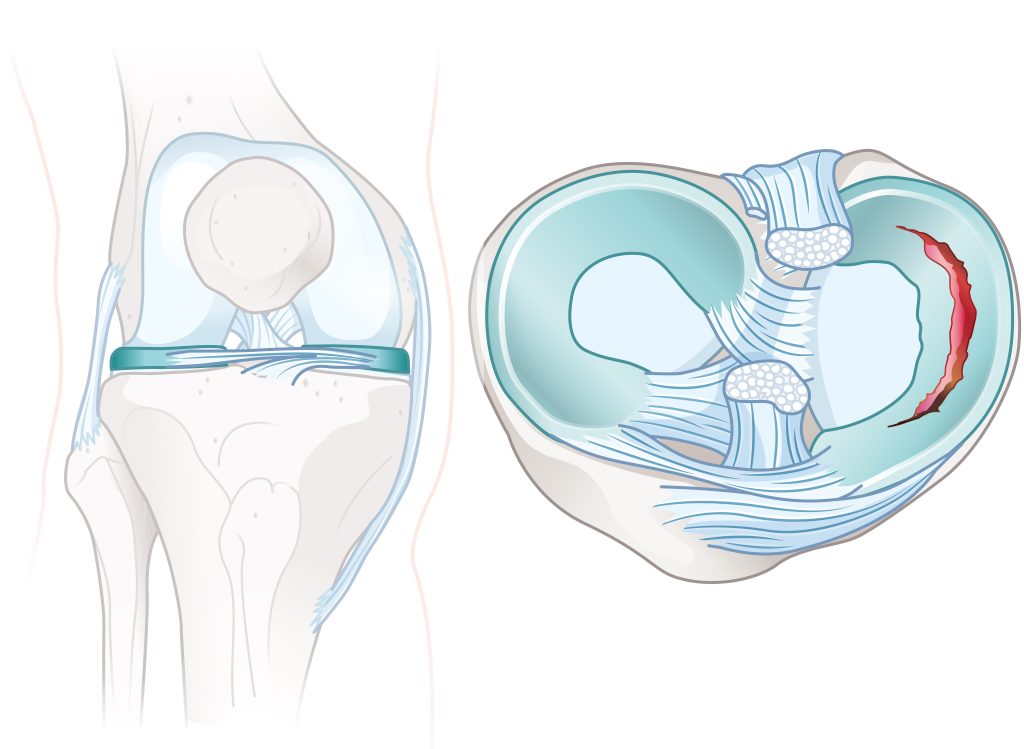
Meniscal tears
The meniscus acts as a shock absorber within the knee.
A tear in the meniscus is one of the most common causes of catching or locking symptoms.
Patients often describe:
- Pain along the joint line
- Clicking or catching during movement
- Difficulty fully straightening the knee
- Intermittent swelling
Meniscal tears can occur following a twisting injury or gradually as part of the ageing process.
Osteoarthritis
Arthritis can also cause clicking, grinding and catching sensations within the knee.
As the smooth cartilage surface becomes worn, movement within the joint may become less smooth.
Patients with arthritis may also experience:
- Stiffness
- Swelling
- Pain when walking
- Difficulty with stairs
- Pain at night
Mechanical symptoms are often more noticeable as arthritis progresses.
Loose bodies within the knee
Occasionally, small fragments of cartilage or bone can become detached and move freely within the joint.
These are known as loose bodies.
Loose bodies can cause sudden episodes of:
- Locking
- Catching
- Sharp pain
- Temporary restriction of movement
Symptoms may come and go depending on the position of the loose fragment within the knee.
Ligament injuries and instability
Some patients describe a sensation of catching or locking when the underlying problem is actually instability.
Previous ligament injuries, particularly involving the ACL, can alter the way the knee moves and functions.
This may lead to episodes where the knee feels unreliable or gives way during activity.
When should you seek specialist advice?
It is sensible to seek assessment if:
- Clicking is associated with pain
- The knee is locking or catching regularly
- You are unable to fully straighten the knee
- The knee is swollen
- Symptoms are affecting work, sport or daily activities
Early diagnosis often allows treatment to begin before symptoms become more significant.
What treatments are available?
Treatment depends on the underlying cause.
Options may include:
- Physiotherapy
- Activity modification
- Pain relief medication
- Injection treatments
- Surgery where appropriate
Many patients improve with non-surgical treatment, particularly when symptoms are identified early. Depending on the diagnosis, treatments such as platelet-rich plasm (PRP) injections may be considered as part of a broader treatment plan.
In some cases, treatment may help patients delay surgery.
Could surgery be required?
Not everyone with a clicking or catching knee requires surgery.
However, surgery may be considered when:
- Symptoms persist despite non-surgical treatment
- The knee repeatedly locks
- A significant meniscal tear is present
- Arthritis has become advanced
The most appropriate treatment depends on the diagnosis, symptoms and individual goals.
Specialist assessment
If your knee is clicking, catching or locking and symptoms are affecting your quality of life, a specialist assessment can help identify the underlying cause and discuss the most appropriate treatment options.
Early treatment often helps patients return to activity and prevent symptoms from becoming more troublesome.
Mr Philip Dobson, Consultant Orthopaedic Surgeon offers consultations and treatment at Nuffield Health Newcastle